Supply of Search Results – EPO Rule Changes from 1 Jan 2011 (R.s 141 & 70b EPC)

On 1st January 2011 new Rules 141 and 70b EPC come into force. They stipulate new requirements for supplying search results on priority applications. The rule changes apply to European patent applications filed on or after 1 January 2011 (including divisional and international applications).

Search Results - w/ thanks to Niklas Bildhauer

While the current version of the EPC (European Patent Convention), in the form of Article 124 EPC, allows for the European Patent Office (EPO) to invite the applicant to provide information on prior art cited on related applications, it has generally only been used in rare occasions on individual cases. However, following a successful pilot program, the EPO has added more teeth to the provision; worryingly appearing to head in the direction of the onerous (and somewhat confusing) US Information Disclosure Statement (IDS).

Amended Rule 141 EPC

Amended Rule 141(1) EPC requires that the applicant provide a copy of the results of any search that was carried out on a priority application when filing a convention European application or when entering the regional phase in Europe. (If the results are unavailable they must be filed “without delay after such results have been made available”.)

Now, I expect most of you are saying: “what if I do not provide these results?”

  • If the priority application is a GB patent application (with existing search results), you do not need to worry: the kind gentlepeople of the UKIPO will (they promise) provide a copy of the search results to the EPO. This should be a relief to UK based EPAs whose UK clients file GB priority applications with a view to obtaining search results within the priority year.  However, I would keep an eye on the exact implementation of this exchange.
  • Amended Rule 141(2) EPC provides for other automatic exchanges to relieve the burden on the applicant. Keep your eyes open for details of such exchanges in the coming months.
  • If no automatic exchange exists, Amended Rule 141(3) EPC enables the EPO to issue an invitation with a 2-month time limit requesting the search results.
    • It is not entirely clear what happens if you fail to reply to the invitation. The likely answer is nothing. As amended R.141(3) EPC explicitly mentions Article 124(1) EPC, it is assumed the “invitation” of amended R.141(3) EPC implements the “invitation” present in Article 124(1) EPC. Article 124(2) EPC states that the sanction for failing to supply search results is the application is deemed to be withdrawn; however, it is not clear whether Article 124(2) EPC will apply directly to this invitation (i.e. deemed withdrawn if you do not reply) or whether R.70b (discussed below) will implement the sanction of Article 124(2)EPC. The latter interpretation looks the most likely.

Amended Rule 70b EPC

Assuming that nothing happens if you fail to supply search results when requested under R.141(3) EPC, the case will proceed happily along to examination. At this point amended Rule 70b(1) EPC gives the Examining Division the power to spot your evasion and issue (another) invitation to provide search results.

If no reply is provided the application is deemed withdrawn (amended R.70b(2) EPC). However, amended R.70b EPC does give you the option to file a statement saying that the search results are unavailable. It is unclear what would happen if you provided this statement with knowledge that it was incorrect.

As amended R.70b EPC only kicks in at the start of examination, there will likely be no ongoing duty to disclose search reports (cf. US) – the European Examiners simply wish to check other prior art searches before starting substantive examination (although this is not confirmed).

Practical Advice

On receipt of new cases, EPAs should check for a priority claim. If at least one priority application exists they should ask the instructing party for a copy of any search results issued on the priority application(s).

As a matter of practice, EPAs should begin requesting that search results are supplied for convention EP and ex-PCT cases. If the priority applications are accessible via online patent inspection sites this should be noted as search results may be supplied without requiring lengthy communication chains.

More Details

EPO Notice: http://www.epo.org/patents/law/legal-texts/journal/informationEPO/archive/20100803.html .

IPKat Post: http://ipkitten.blogspot.com/2010/08/rule-141-and-further-epo-obstructions.html (interesting discussion in the comments on possible variation between the different languages).

**Update**

The EPO has added a number of exceptions which removes the bite somewhat. See post here.

“Software” Patents in the UK – Practice Notices

If you want to understand how the UK Intellectual Property (i.e. Patent) Office exams patent applications relating to “software”*, a good place to start is the most recent Practice Notice:

Patents Act 1977: Patentability of computer programs (Recent= 8 December 2008).

The most recent Practice Notice builds on a previous Notice:

Patents Act 1977: Patentable subject matter (dated 2 November 2006).

This previous Notice was also updated by short Notice:

Patents Act 1977: Patentable subject matter (7 February 2008) .

* By referring to software in inverted commas I am indicating that the term “software” patent is not often used within the profession, which prefers the terms “computer programs” or “computer-implemented inventions”.


With regard to protecting computer games at the UK IPO see the Practice Notice:

Patents Act 1977: Patentability of games (updated 2 November 2006).

Basically, games are not patentable. Paragraph 4 of the Notice is superseded by the Practice Notices above.

EPO Forms – A Spotter’s Guide

My good colleague David O’Connor has recently delved into the murky world of the EPO rule changes and has come up with some interesting findings.

Communications before Search Report

There are three new communications sparked by the recent change in the EPO rules:

  • Form 1056A – this sets out an objection under new Rule 62a.
    • It sets a two-month time limit (from the date of the form) in which to elect a single independent claim in each category (apparatus, method etc) for search.
    • If no election is made the first independent claim in each category is searched.
    • Beware: you will not be able to later limit the claims  to unsearched subject-matter.
    • Often seen: when US claim sets are filed without amendment.
  • Form 1056B – this sets out an objection under new Rule 63.
    • It sets a two-month time limit (from the date of the form) in which to indicate the subject-matter to be searched.
    • If no indication is made the European Patent Office (EPO) may only partially search your claims (or give-up and say no search could be performed).
    • Often seen: when business method / software claims are filed, or following the filing of poor translations.
  • Form 1056C – a rarer beast, a chimera of both objections.
    • Found following, for example, the filing of a poor translation of a Japanese business method.

The parasitic form 2906 may sometimes be found attached to any of the above, offering an explanation of the objections. A lack of unity objection can also be additionally raised.

Beware there is no extension available. Further processing is ruled out.

A lesser spotted 1056A

Communications following Search Report

Some new faces, old favourites and contemporary twists:

  • Form 1081 – issued when an examination fee is due 6 months after publication of the search report (R.70(1) EPC).
  • Form 1082 – issued when the examination fee has been paid, the applicant must indicate whether they wish to proceed with examination (R.70(2) EPC).
  • Form 1224 – same as form 1082 for ex-PCT applications, where a supplementary Search Report is drawn up by the EPO.
  • Form 1083 – issued when the examination fee has been paid and the applicant has waived their right to indicate under R.70(2)EPC. This is a plainer specimen simply providing publication details.

The addition of new rule 70a EPC spices things up a little. This rule requires a mandatory response to the Written Opinion of the Examiner that accompanied the Search Report. If a response is not filed the application is deemed to be withdrawn. The time limit is that set by R.70(1)/(2), which is now mostly six months.

Following all these changes, you will notice some extra plumage at the foot of the forms:

Bottom of the Form
Look closely now

The form number is first visible on the left-hand-side. This is followed by a date (I am guessing month and year of last form revision). Then we have same strange codes:

  • OFS/NFS – we believe these refer to Old Fee System and New Fee System, presumably indicating the fees that apply if any are due.
  • RTB/non-RTB – through a process of Holmean deduction, it is pretty much assured this refers to the EPO’s beloved “Raising the Bar”, a phrase of almost political vacuity. Basically if you see “RTB” on a form it means the new rules apply;  “non-RTB” means the old rules apply.
  • ESOP01=Y/ESOP01=N – translates as European Search Opinion is positive (says “yay”) and European Search Opinion is Negative (says “nay”).  Following a positive opinion one would assume that there are no deficiencies to address and thus that no response need be filed. Following a negative opinion there will be deficiencies to address and thus a response will be needed to avoid the application being deemed withdrawn.

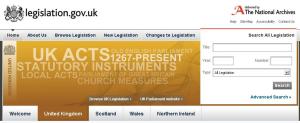
Legislation.gov.uk

The National Archives have a new shiny website for UK Legislation:

http://www.legislation.gov.uk

The site is actually pretty good and a great improvement over the old HMSO offering (Her Majesty’s Stationery Office if you are wondering – the Queens personal stationery cupboard) . The design is simple enough even attorneys can use it.

For example, typing “patent” as a search term brings me a list all patent related acts and statutory instruments. These can be ordered by date or title. You can even view an Act from 1571. (Trade Mark professional can type “trade mark” for similar fun; if you get bored of IP (or need to sleep) you can also look up the A27 Trunk Road (Shoreham Bypass) Traffic Restriction Order 2010.)

Once you select an item you can choose to view the original legislation (as enacted) or the latest available (as revised). You can also collapse certain sections, print to PDF or HTML, and view a plain text version. When viewing the latest version, amendments are clearly identified and a hyperlink to the implementing legislation is provided.

To be honest, I find it easier to use than the Legislation section of Westlaw. And, unlike Westlaw, it’s free (well, paid for by UK tax payers).

EP & US Excess Claims Fees

Patents can be an expensive business. However, there are a number of ways you can reduce the fees for a new application.

Today: claims fees.

Many national patent offices punitively price excess claims fees to make their jobs easier during examination. It is fairly easy to be caught out by this practice and see your official fees double for fairly little return.

Stack of Euros with thanks to Andres Rueda

In Europe excess claims fees are due for all claims over 15.  The 16th to 50th claims have fees of 210 euros each. Each  claim over 50 has a fee of 525 euros. (Correct as of 6 August 2010 – see here for current fee schedule).

In the US excess claims fees are due for all claims over 20. Each claim over 20 has a fee of 52 dollars.  Independent claims in excess of 3 have a fee of 220 dollars. Multiple dependent claims get hit with a 390 dollar fee. (US fees are reduced by half for a small entity – correct as of 6 August 2010 – see here for current fee schedule).

If you are thinking about filing a patent application in Europe or the US, and the issue has not been raised, ask your patent attorney about whether there are any claims fees payable on your application. If there are you may wish to reduce the number of claims within your claim set, remove multiple dependencies or reduce the number of independent claims. Often dependent claims of limited value can be cut (e.g. claims of the form: “and the result is displayed on a display device…”).

If possible aim for a maximum of 15 claims in Europe and a maximum of 20 in US.

If further possible aim for no multiple dependencies and a maximum of 3 independent claims in the US.

EPO & R.161 Shenanigans

Those of you on EPO Communication Watch may have noted the insertion of a new paragraph in the R.161 “B” Communication.

It appears the EPO are getting annoyed by Applicants avoiding a compulsory reply to the new R.161 EPC Communication by filing any old amendments or comments at regional phase entry (see previous post). They have thus added the paragraph below in threatening bold type:

“Please note that, should you have already filed comments/amendments, which however do not address the deficiencies noted in the written opinion of the International Searching Authority or in the International Preliminary Examination Report or in the explanations pursuant to Rule 45bis.7(e) PCT to the Supplementary International Search Report, and should you choose not to react to the present communication, further amendments of the application documents can only be made with the consent of the Examining Division (R. 137(2) and (3) EPC).”

This paragraph simply reminds Applicants that this is the last point at which voluntary amendments may be filed; however, the sub-text appears to be: file a proper response or else. The problem is, legally, R.161 is a bit of a mess and there is no real “or else” sanction; Applicants can continue avoiding a compulsory reply in the usual manner.

It will be interesting to see whether the EPO begin to change practice to force earlier substantive amendment.

PCT Rule Changes – 1 July 2010

The eagle-eyed among you may have noticed some minor changes to the PCT Rules that came into force on 1 July 2010. Changes to practice appear negligible.

Amendments (to keep the EPO happy):

  • You need to provide basis for claim amendments (Rules 46.5(iii) , 66.8(a),(c)).
  • Penalty for non-compliance: International Preliminary Examination Authority (IPEA) may ignore your amendments when drawing up the International Preliminary Examination Report (IPER – Rule 70.2(c-bis) ).

Supplementary International Search (SIS – this came in on 1 January 2009: keep up):

  • The Supplementary International Search Authority (SISA) may consider a SIS-request not to have been made if it covers claims it will/can not search (Rule 45bis.5(g),(h)). For example, EPO will not search business methods from the US.
  • SISA may limit the number of claims they search (Rule 45bis.9(c)).

Fee Amounts (stop reading – not important):

  • The calculations used to come up with non-Swiss currency equivalents have changed.

“Software” Patents in Europe

Well, to be precise, computer-implemented inventions under the European Patent Convention.

The Enlarged Board of Appeal has just issued a decision in referral G03/08 (for background see here). The Enlarged Board have decided that the referral is inadmissible. The accompanying opinion states that previous decisions of the Boards of Appeal are not sufficiently “different” (i.e. “conflicted”) to warrant clarification from the higher Enlarged Board.

Better men than I have summarised the decision here:

http://www.ipjur.com/blog2/index.php?/archives/150-EPO-EBoA-Opinion-in-re-G-0308-Patentability-Of-Computer-Implemented-Inventions.html

http://ipkitten.blogspot.com/2010/05/g-308-software-patents-decision-is-out.html

[Update] and here: http://www.iam-magazine.com/blog/Detail.aspx?g=cc296bce-5de8-484c-ac43-95d5b6ce68df featuring Gill Jennings & Every‘s Peter Finnie

To be honest, the decision was pretty much expected: the European Patent Office (EPO) has been taking a fairly consistent approach to computer-implemented inventions and has a growing body of learning materials on the subject. In fact, by no small coincidence, the book “Patent Law for Computer Scientists“, written by EPO Patent Examiners was released a few days ago. I have ordered a copy and will let you know if it is of any use. A review can be found here.

However, the opinion is not without merit. Its 60-odd pages set out the current state of the law on the issue and may provide a useful caselaw summary. I will attempt to read through the pages of dense courier font shortly.