
Case Law Review – BL O/244/13

Case:

BL O/244/13

Claimed Subject Matter:

The invention relates to a method of synchronizing data, including representing messages as text or binary property list files (plist). The synchronization protocol provides for exchanges between a client and server in which separate sync modes (e.g. fast, slow, reset) are associated with different dataclasses and the dataclasses can be updated in parallel. This is achieved by proposing and agreeing the sync mode for each dataclass; sending sync-start, syncchanges and finally a sync-commit command between client and server.

Applicant: Apple Inc.

Claim 1 was directed to a server-side method and claim 10 was directed to the sychronization server.

Comments:

The alleged contribution was deemed to be:

Synchronizing data including initiating a sync session by receiving a request comprising a separate proposed sync mode for each of multiple data classes, specifying changes to data of the multiple data classes, using a status code to indicate whether the sync mode for each dataclass is accepted, in accordance with the sync mode for each dataclass, updating the data and selectively committing the changes, which means that a reduced number of messages is required to be transmitted. (Paragraph 23.)

The Hearing Officer deemed that the contribution was not a method for doing business as such:

The synchronised data may be ‘business data’, and the method of synchronising it may be performed in the course of business, but the contribution to data processing is broader, for example including the  provision and processing of sync modes and does not, to my mind, mean that the contribution falls within the category of a method for doing business as such. (Paragraph 25.)

However there was more debate as to whether the contribution was a computer program as such. To determine whether it was, the five signposts from AT&T (paragraph 40) were considered.

The Hearing Officer was not convinced that saving bandwidth by reducing a number of messages was an effect provided by a communication process outside of a computer. Instead, the number of messages was reduced inside the computer. Hence, the first signpost was not satisfied (see paragraph 29).

Reviewing the reasoning in relation to the second signpost, I believe this is most open to counter-argument. In paragraph 31, the Hearing Officer found that the effect was dependent on the type of data being processed: sync mode data. However, he also argued that the contribution was defined in terms of data processing and not the nature of the data being synchronised. In sum, the Hearing Officer is saying that the contribution is dependent on a particular type of control or metadata, but that the data it is applied to can be anything.  The Hearing Officer was of the opinion that this contra-indicates a technical contribution. I could disagree – the same reasoning could also be used to demonstrate compliance with the second signpost.

With regard to the third and fourth signposts the Hearing Officer concluded that the computer implementing the invention was not changed by the invention:

All that has changed is the number and format of the messages transmitted. (Paragraph 36.)

As such the fifth signpost was also answered in the negative. As none of the signposts indicated a technical contribution the Hearing Officer concluded that the invention was a computer program as such and the application was refused.

Without delving into the detailed facts of the case the decision seemed a bit harsh. It appears to follow reasoning similar to Hitachi (T 258/03) and apply it to subject matter that in my mind is more technical. It appears to follow similar recent decisions by the European Boards of Appeal that clamp down on the “relieves bandwidth by reducing messages” argument that is often applied in these cases.

One interesting question to consider is: would the decision have been the same if the independent claims covered a system of two entities, a client and a server? If the answer is yes then this appears unfair to parties that only supply one side of the communicating equipment.

The case does nicely illustrate how the UK Intellectual Property Office (IPO) evaluates patentable subject-matter. The framework displayed in the decision can be applied to most patentability cases at the UK IPO.

Immediate Refusal – When can the European Examining Division refuse an application?

Friday afternoon: office debate on the European Patent Convention (EPC).

The question that arose was: when should you request Oral Proceedings in a written response to the European Patent Office?

With the European Patent Office providing a form of “examination” at the search stage (the “Written Opinion”), it is now mandatory to respond to any objections raised therein before “examination” officially begins (via Rule 70a EPC). In this response should you request Oral Proceedings?

The question then becomes: can the Examining Division refuse a European patent application in the “first” examination communication under Article 94 EPC?

For

The case law that was laid down under the old rules (i.e. with no “Written Opinion”) held that a decision to refuse could legitimately be issued by the Examining Division as a second communication, i.e. no “further” communication under Article 94(3) EPC (nee Article 96(2) EPC 1973) was necessary. See the link for more details. This generally applied to cases where the applicant made no effort to address any objections raised in a first communication.

If these cases are applied to the present set of circumstances, where the “Written Opinion” is practically a first “examination” communication, it could be argued that the Examining Division can legitimately refuse the application without issuing an official examination communication (e.g. with a second communication relating to substantive issues). It could be argued that the right to be heard, set out in Art. 113 EPC is met, as the applicant had the chance (moreover had) to respond to the Rule 70a EPC communication.

However, if this is the case, and a request for Oral Proceedings is made in the response to the R.70a EPC communication, is the request made to the Examining Division or the Search Division? A request to the Search Division may not be valid as the Search Division cannot refuse the application. As the Examining Division “take account” of the response (see here), does this pass on the request in a valid manner?

Against

Article 94(3) EPC states that:

 “the Examining Division shall invite the applicant, as often as necessary, to file his observations and…to amend the application”.

Now the “shall” in this provision seems to suggest that at examination the applicant should have one opportunity to file observations and/or amend the application. This would rule out a decision to refuse as the first examination communication.

However, the “as often as necessary” complicates matters – if the applicant has not responded to substantive issues in a Written Opinion at the Rule 70a EPC stage, is it necessary to give them another chance? Does “as often as necessary” mean one or more times (consistent with “shall“) or does it make the “shall” conditional (zero or more times)?

If anyone is aware of any case law or guidance that clears this up please let me know.

Online Patent Registers in United Kingdom, France and Germany

Many European patents are validated in United Kingdom (UK/GB), France (FR) and Germany (DE). This results in equivalent national patents in each of these countries. Obtaining status information on these individual national patents is getting easier everyday.

The European Patent Office is soon to release its “Federated Register”. This will allow you to access national patent registers via the European patent register. A new tab is provided on the left-hand side of the pre-existing European patent register to access this feature.

While we wait for the Federated Register you may find the following links useful:

Just enter the equivalent European patent publication number (e.g. EP1234567) in the “publication” field and off you go. I tend to print the displayed results to PDF to have a dated static record.

Update

A helpful colleague alerted me to an easier way to see the status of a European patent on the national registers.

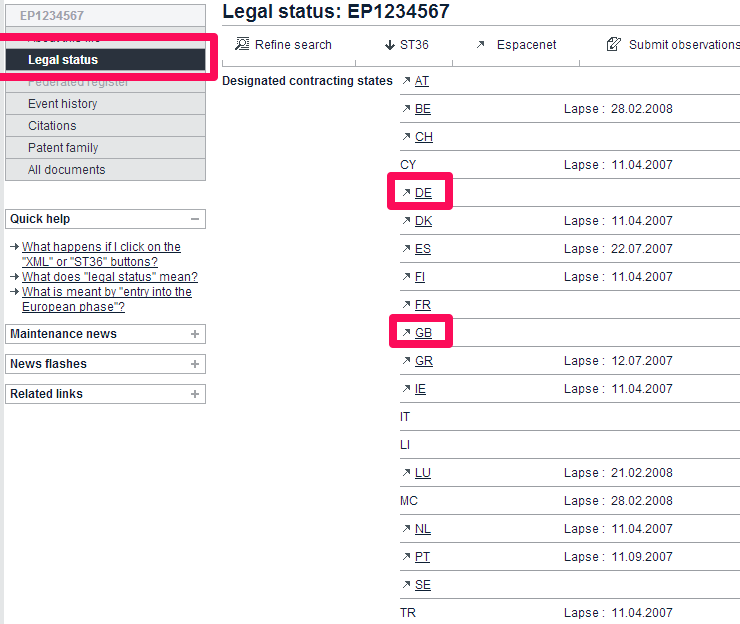
On the European Patent Register click “Legal Status” – you can then click on the countries to hyperlink to the appropriate national register.

Easy!
Easy!

Patent Pending in the UK

You are in UK. You have spent thousands of pounds on a UK or European patent application. How can you reap some return on this investment without suing someone?

The band "Patent Pending" taken by Jtdscape
The band “Patent Pending” taken by Jtdscape

One way you can do this is to show that you have applied for a UK or European patent application in your marketing material. You may want to tell the world that your product or service is new and innovative. You may also want to put some distance between yourself and your competitors.

In the UK can mark your product or service as “patent pending”, but this comes with some caveats:

  • It is an offence to mark your product or service as “patent pending” when you do not, in fact, have a UK or European patent application (see Section 111 of Patents Act 1977). To clarify, you will not have  a UK or European patent application if:
    • the obvious one: you have not filed a UK or European Patent Application; and
    • the slightly less obvious ones:
      • you have filed a first application outside of the UK or Europe and have not filed a priority-claiming UK or European patent application;
      • you have filed a International (PCT) Patent Application but have not entered the UK or European phases after 31 months; and
      • you have filed a UK or European Patent Application but it has been considered withdrawn or refused.
  • We now live in a global world. A web-based service is accessible from anywhere on the globe and many business ship worldwide. If you mark a web-site as “patent pending” when you have a UK or European Patent Application, someone viewing the site from outside the UK may assume you have a patent pending in their territory. This could get you into legal trouble. Hence, it is recommend to specify that you have a “UK patent pending” or a “European patent pending”. For a belts and braces approach you may wish to add the application number.

If something changes and you no longer have a UK or European patent application, you have a “reasonable” amount of time to change your marketing materials, product and/or website. As this is a bit woolly, and will vary for each case, it is recommended to instruct that information is changed within 3 months of notification of the change (e.g. after receiving an email from your patent attorneys saying that your application has been refused).

Case Law Review – T 972/07

Case:

T 0972/07

Claimed Subject Matter:

System and method of assisting goods collection (e.g.  to salvage the lens in disposable cameras).

Comments:

The appellant argued that the invention related to the recycling of goods, which they believed was technical.

The Board of Appeal disagreed. They argued that the invention was essentially concerned with logistical matters of collecting and distributing goods prior to the recycling process. It is those logistics that had to be examined for technical effect, not the recycling process, which is not claimed. In the present case, those logistics were found to be administrative in nature and lacking in technical character. The remaining technical features were simply well-known computers and databases. Any dependent claims related to improvements to the administrative method rather than the technical features.

This case can be distinguished from T 1411/08 wherein the case was remitted to the department of first instance to perform an additional search on the basis that the Examining Division did not convincingly demonstrate that certain technical features were “notorious”

Case Law Review – T 907/09

Case:

T 907/09

Claimed Subject Matter:

Valuation of a futures contract.

The application relates to data processing systems and methods for assessing the failure risk of a bundle of constructs that may individually fail. A resource amount is determined so as to counterbalance the failure risk when it is transferred. The risk assuming entity receives the resource amount.

Comments:

The claimed system is defined functionally in terms of means for storing and processing spread values and for continuously calculating a resource amount which reflects a value of a futures contract (which is based on a basket of credit default swaps). The claim is not limited to a technical field of application; on the contrary, its final paragraph emphasises a commercial goal.

The Board does not see any technical effect in knowing the resource amount or failure risk of a bundle of credit default swaps. The overall effect of the claimed system is that a mental, mathematical, commercial or administrative result is provided: What premium does the owner of the bundle have to offer so that another market participant is willing to take over the failure risk of the bundle?

Case Law Review – T 1261/08

Case:

T 1261/08

Claimed Subject Matter:

Electronic trading – system for settling over the counter trades.

Whether a trade will be settled bilaterally or through clearing depends on the preferences of the party to accept the offer. If the party making the offer has bilateral trading closed with a particular counterparty and the counterparty does not permit cleared trading of the product, the product will show up as red on the trading screen. If trading is possible, the product offer will show up as white. The colour coding acts as a means for indicating whether trading is possible while preserving the parties’ anonymity.

Comments:

The Board confirmed that business aspects of an electronic exchange, such as parties’ trading preferences, do not constitute a technical contribution and, thus, do not enter into the examination for an inventive step.

However, displaying data indicative of the availability or unavailability of a computer-implemented function may be considered as a technical feature independent of any cognitive or aesthetic aspect of its presentation and independent of any business aspect of the underlying computer-implemented function. The technical character of the implementation of such an indication is not wiped out by its commercial goal.

Despite this, a feature of binary colour coding, as found in the claim in question was, in the technical context of user terminals, a notorious way of indicating the availability or unavailability of a computer-implemented function. In addition, there could be an argument that it related to a presentation of information as such.

The appellant also made reference to a granted case in the field of transaction data processing. The Board dismissed this – a granted patent is not a case law precedent and so should not be commented on or compared with the case in question.

Case Law Review – T 2217/08

Case:

T 2217/08

Claimed Subject Matter:

Detection of files that do not contain executable code (Microsoft).

The claim was found to differ from the prior art by the fact that:

a. parsing comprises the step of parsing said input file with all the component parsers, said parsing continuing even if a component parser has already recognized said file format;

b. the compound parser is configured to allow extension by addition of a new component parser to the compound parser, the new component parser recognizing a further file format and recognizing executable code within the further file format and

c. the input file is stored only if no executable code has been found.

Comments:

The Board of Appeal debated whether a step of “parsing” per se had technical character. They concluded that it did not necessarily rely on technical considerations or have technical effects – i.e. it may lack a technical character in certain cases.

In the case in question the appellant added a concrete step of “storing” based on the output of the “parsing” step. The Board of Appeal concluded that the storage of a file was a technical step that provided a further technical effect. This could then lend technical character to the preceding “parsing” step.

Patenting Software – Can You Protect Programming Inventions in the EPO?

This article is a brief summary of the European Patent Office position on patenting inventions associated with computer programming.

Overview

It may be easier to obtain a granted patent for computer programming inventions when an application is made via the European Patent Office rather than the UK Patent Office.

However, the European Patent Office may be more likely to raise clarity objections and find relevant prior art.

Defining Case: COMVIK

The defining case in Europe is COMVIK.

Following this case, the claims of a patent application are assessed for “technical” and “non-technical” features. Only “technical” features may be used to demonstrate an improvement over previous publications.

The term “technical” is necessarily fuzzy; it has been defined in a piece-meal manner by European case law. However, it is generally taken to mean clearly relating to a field of science or engineering. Features relating to “administration” or “business” are considered “non-technical”.

Useful Case Law

The cases below provide examples of the thinking of the UK Patent Office.

  • T_0505/09: in this case, an invention related to a method for identifying defective program code. At an abstract level, certain testing techniques were agreed to form part of the common general knowledge. However, there was no objection that the invention related to “non-technical” features. Instead, emphasis was put on what written evidence relating to the invention was published before the application was filed.


  • T_1893/08: in this case, information on data definitions was provided in the form of a common language file represented in a different language to first and second languages for compilation. The first language had an “import” statement that imported the common language file. The board concluded that compiler features provided a solution to a “technical” problem and did provide an inventive step when compared to the cited art.


  • T_1216/08: this case featured authentication of software in a dynamic loading environment. A validator generated a digital signature based on a portion of a program image, wherein pointers in the image that required “fixing up” by a program loader were excluded from the portion. Implicitly, these features were considered “technical” and an inventive step was found.


  • T_0702/08: in this case, a patent claim referred generally to “process objects” and “task objects”. These terms were considered to have a broad meaning encompassing the general concept of a “goal” or “objective” at an administrative management level. It was concluded that there was no unambiguous correlation between the described “objects” and object-oriented programming. Hence, a specific technical mapping between abstract concepts and their technical implementation needs to be set out in any patent application.


  • T_0077/08: here the main difference between a patent claim and a previous publication was that a business logic rule was expected as an expression rather than a statement in a programming language. It was considered obvious that both formulations would be considered. It was questioned whether making a system more “flexible” was a “technical” problem.


  • T_2078/07: in this case the invention, using metadata to describe data types, was found not to provide “a further technical effect” over fundamental programming conventions. It was “simply an advice on how to write a program”.


  • T_1928/07: this case referred generally to “event processes”, “tasks”, “inclusion” and “execution” in a programming context. These terms were not defined in terms of concrete, rather than abstract, features. The case was thus rejected for lacking clarity.

Patenting Software – Can You Protect Programming Inventions in the UK?

This article is a brief summary of the UK position on patenting inventions associated with computer programming.

Overview

In the UK, it may be difficult to obtain a granted patent for inventions relating to computer programming.

These inventions may not be allowed by the UK Patent Office on the basis that they relate solely to a “computer-program”, a “mental act”, a “business method” or a “mathematical method”.

However, while patent applications for application-level software are most likely to be refused, certain improvements at a low, technical level may be allowed.

Defining Cases: Symbian and Halliburton

The defining cases in this area are Symbian and Halliburton (see links for full references).

  • Symbian concerned adapted dynamic link libraries (DLLs) with two parts: a fixed part and an extension part. Even though it was directed to a method implemented in practice by a computer program, it was found not to be solely a computer program as it made a computer work better as a matter of practical reality. From this case, an improvement at the level of the operating system or below could form the basis of a granted patent. The UK Patent Office appears to dislike the citing of Symbian; frugal use is recommended.


  • Halliburton made it easier to obtain a granted patent for inventions that could be performed mentally. In the past, these would be rejected. Now, inventions that are described as “computer-implemented methods” are not rejected just because the “method” could be performed mentally.

Hearings from the UK Patent Office in this area suggest it will be difficult, but not impossible, to obtain a granted patent for a computer programming invention.

Much will depend on the language of the patent application and the particular examiner considering the case. It must be shown that there is more than would be expected when simply running a better program on a computer.

Useful Case Law

The cases below provide examples of the thinking of the UK Patent Office.

  • O/173/08: the invention involved “taking an existing computer program, analysing the instructions … and applying [parallel processing code] substitutions so that the program will operate more quickly”. This may be performed at runtime using a “rules-based system for converting the original code into more efficient code”. This was found to relate to “the generation of more efficient program code rather than an improvement in the operation of the computer system”, i.e. to be an improvement in “programming” and thus excluded for being a “compute program as such”.


  • O/066/06: in this case, data received from trace units associated with a processor was used to adapt compilation in real time. The Hearing Officer stated that compilers per se were not patentable for being a mental act; it is likely this is now overturned by Haliburton. The result of the invention was “a faster, more accurate compiler, able to adapt and improve in an iterative manner each time the compiler is used”. This was seen to be a “technical” rather than “cosmetic” advantage, and the case was allowed.


  • O/057/06: this case involved the application of a reduced set of Java® Bytecode instructions, i.e. multiple Bytecode instructions were reduced to a single virtual machine instruction. Even though the Hearing Officer acknowledged that Reduced Instruction Set Computers (RISC) were well known, he found that the application related to a non-obvious “invention” under UK patent law. Following from this a patent should be granted. His logic was that hardware-based RISC processors were unarguably patentable, providing a clear technical effect of being faster and more economical. Hence, a software-based version should not be excluded simply because it is implemented on a programmed computer.


  • O/036/10: this case involved a simulation system comprising a new arrangement for debugging software enabling a user to locate bugs more quickly and more effectively. Here, however, the computer running the software was “entirely conventional”. The software made “a computer, work differently in the sense of processing data in a different way, but it [did] not make it work better, faster or more reliably in terms of its performance”. No “deep level” technical improvement was located. Thus the application was refused.